
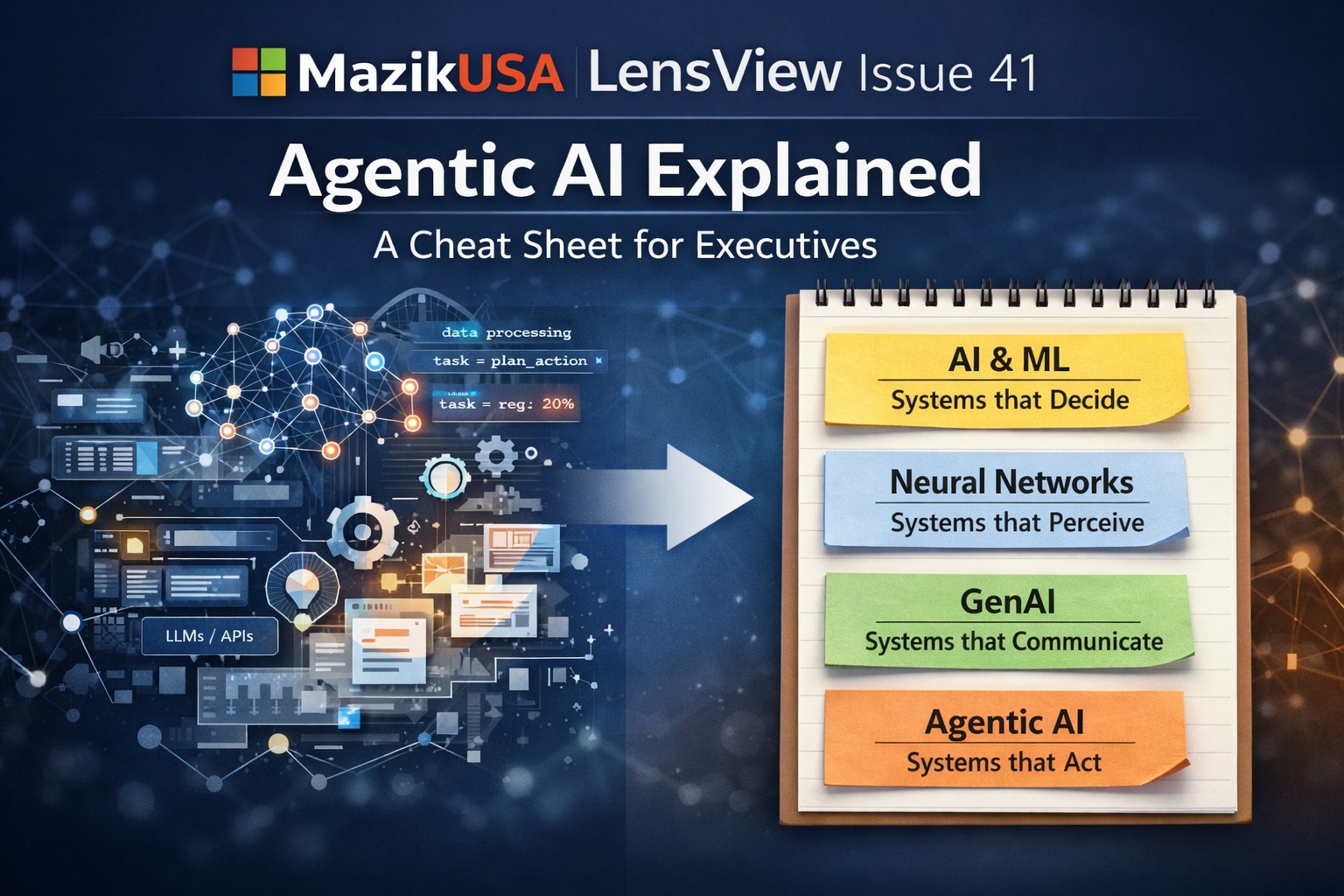
Agentic AI is becoming a central topic in C-suite conversations, yet most explanations are either deeply technical or overly abstract. Many leaders can describe GenAI, but struggle to articulate what makes agentic AI different, how the layers of modern AI relate, and where the technology actually fits inside the enterprise.
This issue provides a concise framework that executives can keep at their desk. It reduces a complex landscape into a set of four layers that define how AI evolves from prediction to autonomy.
1. The Four Layers of Modern AI
This structure organizes today’s AI landscape into a simple progression. Each layer builds on the previous one and describes a different level of capability.
Layer 1: AI and Machine Learning
Purpose: Analyze data and generate decisions.
Includes forecasting, classification, recommendations, traditional supervised and unsupervised models.
This is the foundation of enterprise analytics.
Layer 2: Neural Networks
Purpose: Detect patterns in high-dimensional data.
Includes CNNs, RNNs, LSTMs, transformers, multimodal perception.
This is how machines understand images, audio, video, and complex sequences.
Layer 3: GenAI
Purpose: Generate language, content, and code at scale.
Includes LLMs, RAG, copilots, multimodal interaction.
This is the layer that communicates and synthesizes information.
Layer 4: Agentic AI
Purpose: Take action.
Includes planning, task sequencing, tool use, API execution, state tracking, memory, and coordination among multiple agents.
This is the layer that completes work, not just produces output.
2. The Line That Matters Most
Executives often ask for a single distinction.
GenAI produces output.
Agentic AI completes tasks.
This line helps determine investment strategy, architecture planning, and workflow design.
3. What Agentic AI Enables in Real Systems
Agentic AI introduces autonomy into operational environments. Examples include:
-
Managing ticket queues
-
Executing multi-step supply chain tasks
-
Preparing and routing documentation
-
Coordinating workflow approvals
-
Monitoring systems and escalating exceptions
-
Acting across multiple enterprise platforms through tool use and APIs
This represents a shift from interface-level intelligence to workflow-level intelligence.
4. The Prerequisites for Success
Agentic AI relies on the same principles used in large-scale enterprise systems engineering:
-
Unified, high-quality data
-
Documented workflows with defined decision points
-
Reliable integration pathways
-
Governance and safety controls
-
Monitoring and auditability
-
Outcome metrics aligned to operations
These structural elements determine whether agentic systems function reliably.
5. Why Many Organizations Struggle to Deploy It
Patterns observed across early deployments include:
-
Workflows are fragmented or undocumented
-
Data is siloed across systems
-
Legacy platforms limit automation
-
Responsibilities and boundaries for agents are undefined
-
Governance is implemented after deployment
-
Use cases are chosen without measurable outcomes
These issues cause pilots to stall or become expensive to maintain.
6. Where Partners Like Mazik Fit
Agentic AI requires engineering, workflow redesign, integration, and operational maturity. Execution-focused firms are positioned to support this shift.
Key capabilities include:
-
Translating workflows into agent tasks
-
Preparing data and systems for real-time orchestration
-
Integrating AI with ERP, clinical, financial, and operational platforms
-
Designing governance and monitoring frameworks
-
Providing long-term operational support through global delivery teams
This reduces complexity and improves stability as agentic systems scale.
7. A Desk-Side Reference for Leaders
Executives can use the following as a simple, durable cheat sheet:
-
AI and ML: systems that decide
-
Neural Networks: systems that perceive
-
GenAI: systems that communicate
-
Agentic AI: systems that act
This model clarifies conversations with teams, boards, and vendors without requiring technical depth.
Closing Insight
Agentic AI brings a new operational model into the enterprise based on autonomous workflows rather than standalone tools. Leaders who understand the four-layer structure can evaluate their readiness more effectively, identify gaps, and prioritize investments that support stable and scalable deployment. The simplicity of the framework makes it a useful reference as the technology evolves.


