
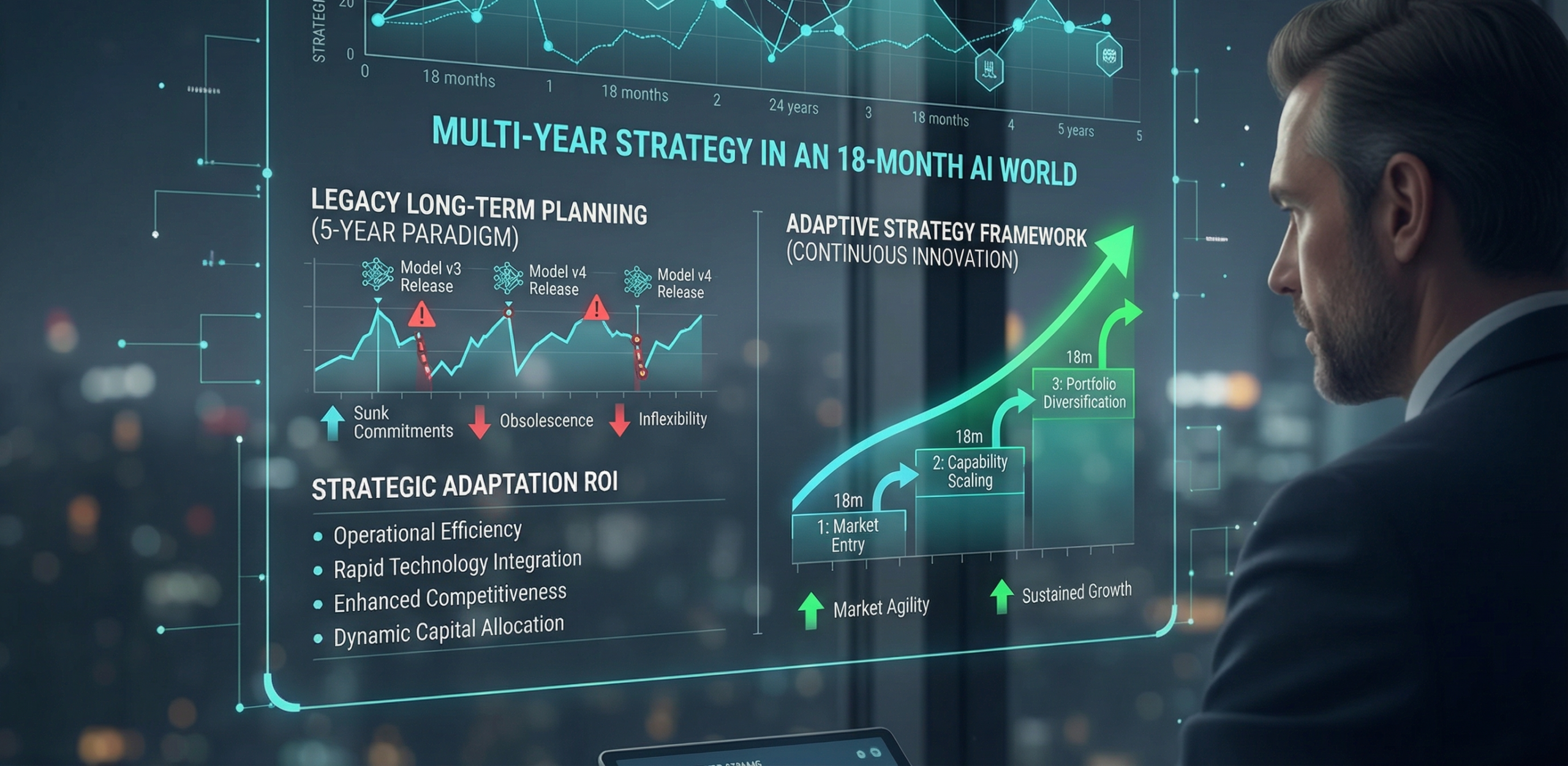
AI strategies are often written as multi-year transformation plans.
Model capabilities, tooling ecosystems, and regulatory frameworks are evolving in cycles measured in months.
Organizations are planning long-term outcomes while operating in short technology cycles.
This tension is becoming a defining characteristic of enterprise AI adoption.
Multi-Year Outcomes Remain Necessary
Organizations still require multi-year direction.
Common objectives include:
- improving forecasting accuracy
- reducing operational cost
- increasing throughput
- accelerating product development
- improving decision support
These goals extend beyond any single technology cycle.
Executive planning horizons remain measured in years because business outcomes require sustained change.
The 18-Month Technology Horizon
However, AI model capability continues to evolve very rapidly.
Within an 18-month window, organizations should expect:
- meaningful changes in model performance
- shifts in cost structure
- new tooling ecosystems
- vendor repositioning
- emerging regulatory guidance
Architectures designed around a fixed model or vendor often require rework as capabilities evolve.
Organizations that plan too far into technical specifics increase the likelihood of redesign before full value is realized.
What Persists Across Model Cycles
Of significant note though, some investments are very likely to retain value across multiple AI cycles.
These include:
- structured data pipelines
- role-based governance
- audit and logging infrastructure
- modular integration architecture
- human review processes
- monitoring and observability
These components support reliability regardless of which models are deployed.
They form the durable layer of enterprise AI capability.
Data Quality Compounds Across AI Cycles
While model capability will continue to evolve, data quality improvements persist across generations.
Organizations investing in data structure, normalization, and classification create a foundation that supports multiple future AI initiatives.
Common areas of focus include:
- standardizing naming conventions
- eliminating duplicate records
- defining authoritative data sources
- structuring unstructured documents
- improving metadata consistency
- aligning data ownership with business roles
These efforts often lack immediate visibility but materially improve long-term success rates.
Clean data improves retrieval accuracy, strengthens analytics reliability, and increases confidence in outputs.
Each successive AI layer benefits from improvements made at the data layer.
This creates compounding returns.
Organizations that prioritize data quality early reduce rework as models and tools evolve.
Data structure improvements often outlast any individual model choice. AI can often be an accelerator as well, in the prep for greater AI advancement.
Early Wins Create Stability
Organizations that progress tend to begin with contained use cases.
Examples include:
- document processing
- operational reporting
- internal decision support
- workflow automation
These projects provide measurable outcomes while governance structures develop in parallel.
Early successes establish confidence and provide a foundation for expansion.
Where Programs Encounter Difficulty
Programs often stall when:
- large-scale transformation initiatives begin without operational validation
- architectures depend heavily on early-generation tools
- ROI projections assume static cost structures
- governance is introduced after deployment
- integration complexity grows faster than organizational readiness
These conditions increase the likelihood of rework.
Sequencing for Adaptability
Organizations that navigate rapid change successfully often follow a consistent sequencing pattern:
- define outcome-oriented objectives
- deploy contained use cases
- build governance structures alongside functionality
- introduce modular architecture
- expand once reliability is demonstrated
This approach allows systems to evolve as technology advances.
Closing Perspective
AI strategies require long-term clarity on business outcomes, coupled with shorter, defined technical horizons to avoid rework.
Execution requires flexibility as technologies evolve.
Organizations that build durable structures around governance, data, and integration can adapt to new models without restarting their programs.
Progress depends on balancing long-term direction with short-cycle execution.


