
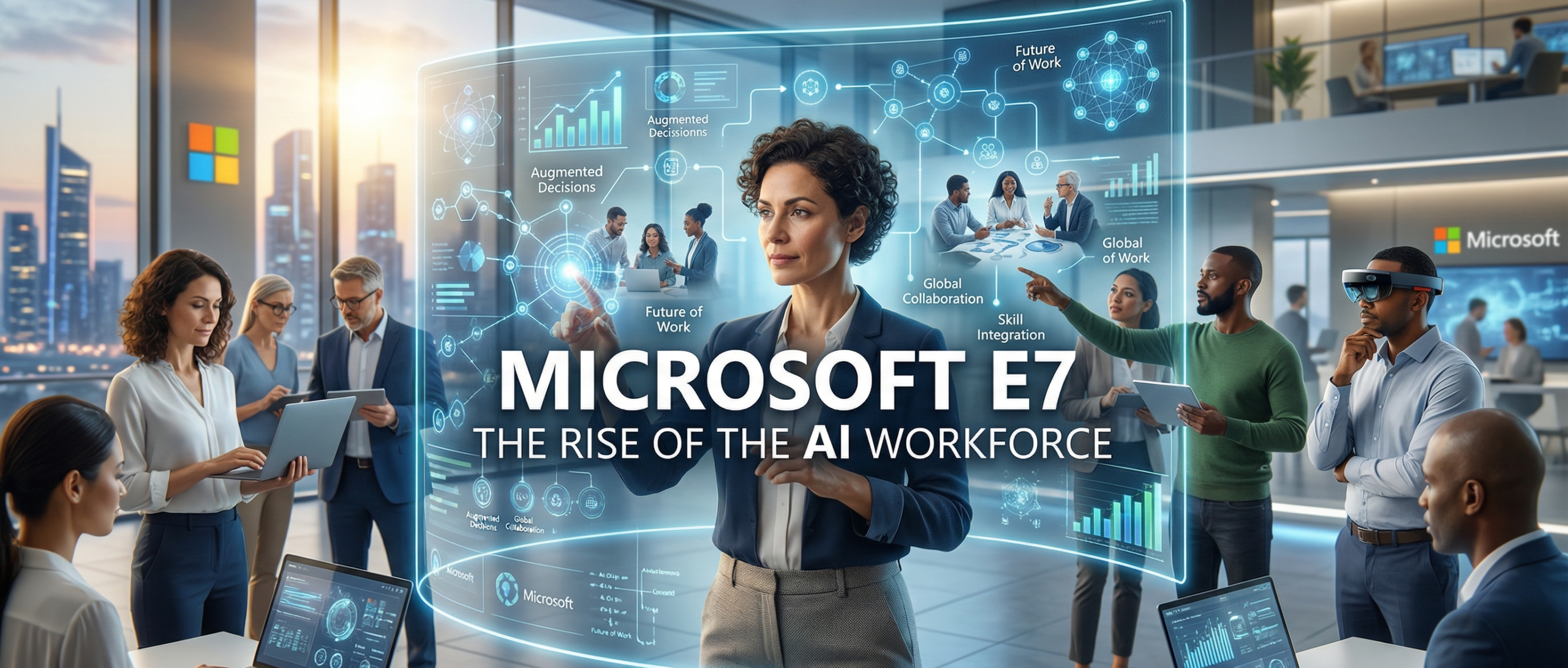
Microsoft’s E7 Licensing: A Structural Shift in AI Deployment
Introduction
Microsoft’s introduction of the E7 licensing concept signals a structural shift in how organizations will deploy AI.
Historically, Microsoft enterprise licensing tiers aligned to productivity, security, and compliance needs. E3 delivered core productivity. E5 extended security, analytics, and governance.
E7 represents a different direction.
Licensing is beginning to reflect the emergence of an AI-enabled workforce operating alongside human employees.
From Productivity Tools to Workforce Multipliers
Traditional enterprise software improved individual productivity.
Word processors improved writing speed. Spreadsheets improved financial modeling. CRM systems improved pipeline visibility.
AI changes the scale of output.
AI systems can now:
- generate content
- analyze large datasets
- summarize complex documents
- assist with software development
- monitor operational activity
- support decision-making processes
These capabilities extend beyond personal productivity improvements.
They introduce a new category of digital labor.
AI Agents as Operational Participants
AI systems are increasingly functioning as operational contributors.
Examples include:
- drafting internal communications
- producing technical documentation
- generating code suggestions
- analyzing customer interaction patterns
- identifying operational anomalies
- assisting support teams
These systems operate continuously and integrate directly into existing workflows.
The concept of a digital assistant is evolving into something closer to a digital team member.
Licensing Begins to Reflect Workforce Structure
Microsoft licensing has historically aligned to user identity.
Each license corresponded to a human employee.
AI introduces new patterns:
- multiple AI copilots supporting a single employee
- AI agents supporting shared workflows
- AI services operating continuously in the background
- AI systems generating outputs consumed by multiple departments
Licensing structures are evolving to reflect these realities.
Organizations are beginning to think in terms of total productive capacity rather than employee headcount alone.
Governance Becomes Central
As AI systems produce operational outputs, governance becomes critical.
Organizations must address:
- access controls
- data exposure boundaries
- monitoring of AI activity
- validation of outputs
- auditability of decisions influenced by AI
These requirements align closely with existing Microsoft strengths in identity management, compliance tooling, and enterprise security architecture.
AI deployment increasingly intersects with existing governance frameworks.
Implications for Organizational Design
The presence of AI contributors affects how work is structured.
Organizations are beginning to consider:
- which activities can be augmented
- which workflows can be partially automated
- where human review remains necessary
- how productivity expectations may change
- how teams coordinate with AI systems
The result is a blended workforce model combining human expertise with AI-assisted execution.
Why This Matters Now
Microsoft introducing an E7 concept signals that AI capability is becoming a core layer of enterprise architecture.
Licensing structure changes typically reflect shifts already underway in enterprise demand.
Organizations are actively evaluating how AI capacity integrates with productivity, security, and compliance investments.
The technology is moving from experimentation toward operational expectation.
Closing Perspective
AI is gradually becoming part of the baseline enterprise environment.
Licensing evolution often reflects deeper shifts in how organizations operate.
The emergence of AI-enabled workforce structures suggests that digital labor capacity will increasingly be considered alongside traditional workforce planning.
Organizations preparing for this shift are focusing on governance, integration, and measurable productivity outcomes.
These elements determine how effectively AI can operate alongside human teams.


