
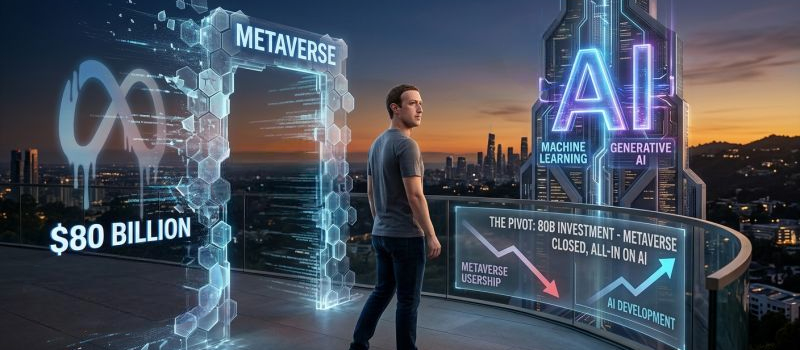
The metaverse was a $80–$100+ billion investment cycle.
Meta Platforms, led by Mark Zuckerberg, made the most visible bet. Reality Labs accumulated more than $80 billion in operating losses since 2020. Annual losses reached nearly $19 billion in a single year. Total spending estimates across the broader metaverse ecosystem exceeded $100 billion.
The expectation was clear. The metaverse would become the next platform for work, commerce, and social interaction.
That shift never materialized at scale.
What the Metaverse Required
The metaverse depended on several changes occurring simultaneously:
- widespread adoption of VR hardware
- new user behaviors inside virtual environments
- new economic systems built around digital goods
Each requirement depended on meaningful behavioral change.
Adoption remained limited. Engagement remained narrow. Enterprise use cases struggled to move beyond pilot environments.
The technology advanced. Behavior did not follow.
AI Is Following a Different Path
AI is expanding inside systems that already exist.
It integrates into:
- spreadsheets
- ERP systems
- CRM platforms
- operational workflows
Users do not need to enter a new environment. Interfaces remain familiar.
The change occurs within existing workflows rather than around them.
AI Produces Immediate Output
The metaverse required value to develop gradually through network effects.
AI produces immediate output.
It generates:
- code
- reports
- analysis
- automation
- decision support
Organizations can measure impact through:
- reduced cycle time
- lower operating cost
- increased throughput
This creates direct connection to business performance metrics.
Enterprise Demand Is Driving Adoption
The metaverse was driven largely by vision and long-term platform positioning.
AI adoption is being driven by operational demand.
- CIOs are funding deployments
- business units are identifying use cases
- competitive pressure is accelerating adoption
AI is being pulled into organizations through measurable outcomes.
Governance Aligns With Existing Structures
The metaverse introduced unclear models for ownership, control, and regulation.
AI introduces new risks within established governance structures:
- data governance
- access control
- auditability
- compliance frameworks
Organizations extend familiar control systems rather than inventing entirely new ones.
The Core Difference
The metaverse attempted to create a new environment for work and life.
AI enhances systems already in place.
One required broad behavioral change.
The other embeds into existing behavior patterns.
Closing Perspective
The scale of investment in the metaverse demonstrates how quickly technology narratives can accelerate.
The scale of AI adoption reflects alignment with existing enterprise workflows.
AI improves productivity, supports decision-making, and integrates with governance models already in use.
That alignment allows adoption to move from experimentation into operational infrastructure.


